Minimum wage in Germany per month: €1,716 after tax (2026)
Short answer: the Germany minimum wage net in 2026 is about €1,716 per month after tax for a full-time job at tax class I, from the official statutory minimum wage (Mindestlohn) of €13.90/hour (≈ €2,409 gross monthly equivalent). That is the figure most people have in mind when they ask what the minimum wage comes to after tax.
The legal floor itself is always gross / brutto (Mindestlohn brutto). Net / after tax depends on tax class, state (e.g. NRW), church tax and health insurance. From 1 January 2027 the hourly rate is scheduled to rise to €14.60.
This is the English guide to the minimum wage after tax, with an infographic and a free calculator. The separate Bulgarian guide (миниджоб, командировки) is Минимална заплата. Free check: calculator with €2,409.
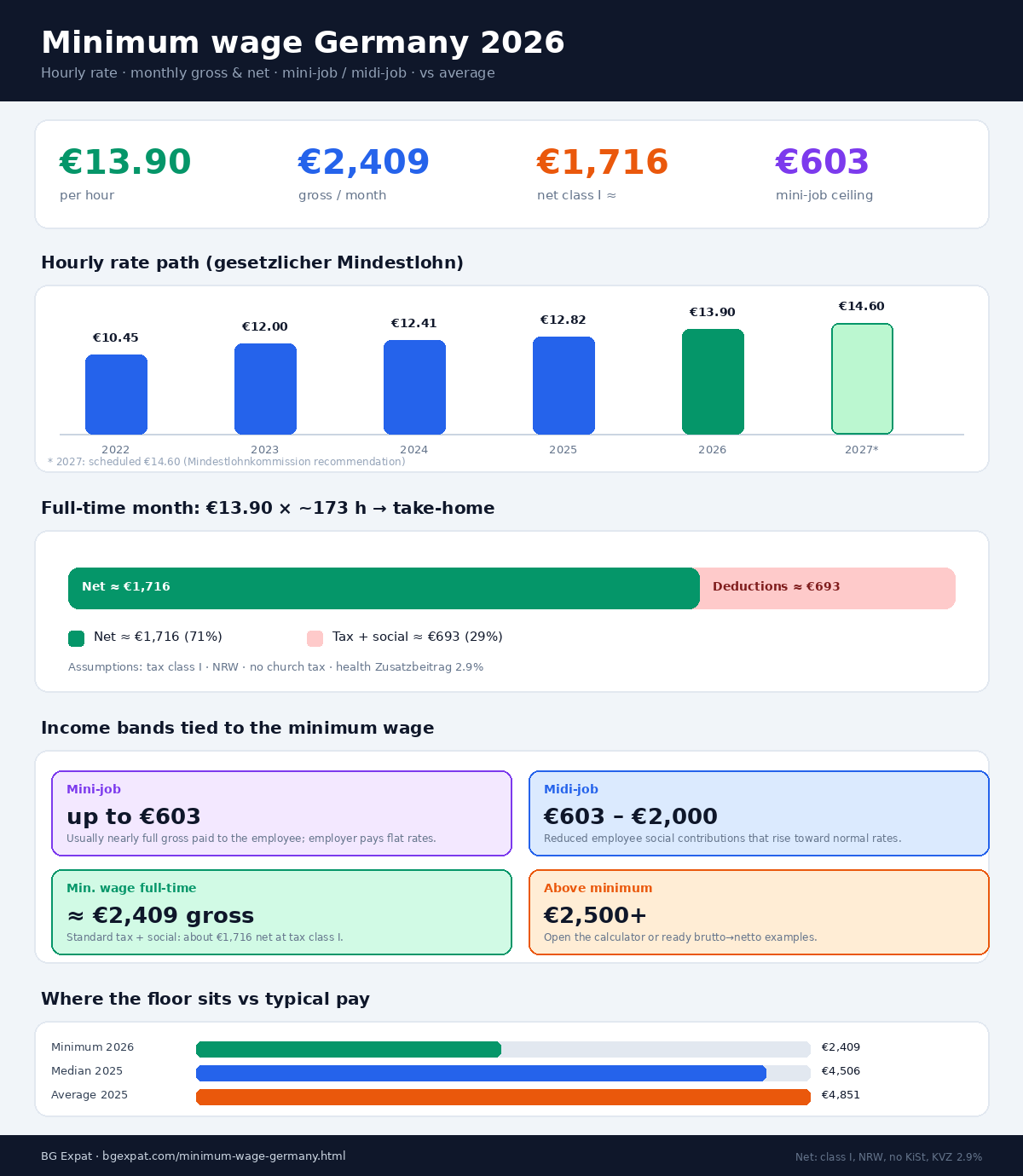
Germany Mindestlohn 2026: €13.90 hourly (official)
The federal Germany minimum hourly wage from 1 January 2026 is €13.90 (BMAS (Federal Ministry of Labour and Social Affairs), §1 MiLoG). There is no separate Berlin or NRW hourly floor for most employees.
| Metric | Amount |
|---|---|
| Hourly minimum (Mindestlohn from 1 Jan 2026) | €13.90 |
| Monthly gross / Monatslohn (full time, ~173 h) | ≈ €2,409 |
| Monthly net ≈ (tax class I, Steuerklasse 1, after tax) | ≈ €1,716 |
| Yearly gross ≈ (€2,409 × 12) | ≈ €28,908 |
| Yearly net ≈ (€1,716 × 12) | ≈ €20,592 |
| Scheduled hourly from 1 Jan 2027 | €14.60 |
| Mini-job monthly ceiling (Minijob) | €603 |
| Midi-job band (Übergangsbereich) | €603 – €2,000 |
Net assumptions: tax class I · NRW · no church tax · health fund additional rate (Zusatzbeitrag) 2.9%. Recalculate in the German tax calculator or home calculator (Mindestlohnrechner / Mindestlohnberechnung).
Minimum wage in Germany per month net (after tax)
The headline hourly rate is gross, but what most people want to know is take-home pay. With the 2026 settings above:
- €13.90/hour statutory gross minimum (Mindestlohn)
- ≈ €2,409/month gross at ~173 hours (minimum monthly wage / Mindestmonatslohn)
- ≈ €1,716/month net at tax class I (~29% deductions)
| Line | Amount |
|---|---|
| Gross (min. wage, ~173 h) | €2,409 |
| Net at class I (approx.) | ≈ €1,716 |
| Net at class III (married, higher earner) | Higher: use the class comparison |
Exact take-home still depends on state, children, health fund and church tax. See the payslip guide and tax classes I–VI.
Minimum salary / minimum pay in Germany 2026
Whether it is called minimum salary, minimum pay or minimum wage, the legal floor is the same: €13.90/hour gross. The useful monthly picture is ≈ €2,409 brutto and ≈ €1,716 netto at class I: not a second, separate salary scale.
Tax class I (Steuerklasse I): single employees
Most single employees without children fall into tax class I. For that case the 2026 net monthly estimate on the minimum wage is ≈ €1,716 from €2,409 gross (NRW, no church tax). Married couples often use class III/V or IV/IV, so net then differs; compare in the class comparison tool.
From hour to month (and year)
Contracts vary (37.5 / 39 / 40 hours per week). A common full-time proxy is ~173 hours per month:
€13.90 × 173 ≈ €2,409 gross / month → about €28,908 gross / year if you multiply by 12 (before special payments). That is the monthly equivalent of the €13.90 hourly rate.
Nearby ready pages: €2,000 (midi zone) and €2,500 (just above the floor).
Minimum wage Berlin: same hourly floor as the rest of Germany
There is no separate Berlin minimum wage and no separate Mindestlohn NRW 2026 for most employees. Berlin follows the federal €13.90/hour (BMAS). Per month that is still about €2,409 gross and about €1,716 after tax in class I. Rent changes living costs. It does not change the legal hourly floor.
Germany basic salary 2026 per month
A job ad that says “basic salary” means the contractual Grundgehalt, the base before bonuses. That is not a second legal minimum. The floor on the hours you work is still the Mindestlohn: €13.90 an hour, about €2,409 gross per month at 173 hours, about €1,716 after tax in class I. A full-time basic salary under about €2,409 gross sits below that floor unless the contract has fewer hours. The average full-time gross is a different figure: Destatis (Federal Statistical Office) reports about €4,851 a month for 2025, excluding special payments. Check a contract in the Mindestlohnrechner.
Mindestlohnrechner: calculate your net
For a full Mindestlohnberechnung (gross → net), open the free Mindestlohnrechner with €2,409. Change tax class, state, church tax and children to match your contract. The table above is the default class-I NRW snapshot, not a personal payslip.
Hourly path since 2022 (Mindestlohntabelle)
The statutory rate has climbed quickly after the 2022 jump to €12.00. Landmark steps (Mindestlohntabelle):
- 2022: €10.45 (mid-year step)
- 2023: €12.00
- 2024: €12.41
- 2025: €12.82
- 2026: €13.90 (current official)
- 2027: €14.60 scheduled (Mindestlohnkommission recommendation)
Mini-job 2026: up to €603
The mini-job ceiling is linked to the minimum wage. In 2026 it is €603 per month. The employee usually pays no wage tax and most social contributions from the pay, because the employer remits flat rates. The exception is pension insurance: unless you apply for an exemption, you top up the employer's flat 15% with 3.6% of your gross. In practice you receive nearly the full gross. Full guide + diagram: Minijob Germany 2026 (hours at €13.90, stacking, midi-job).
If you stack several mini-jobs, the amounts add up. Above the ceiling the employment is no longer “mini”.
Midi-job (Übergangsbereich): €603–€2,000
Between the mini-job ceiling and €2,000 gross per month, employee social contributions are reduced and rise gradually to the normal rates. The goal is to avoid a cliff just above €603. Our calculator applies the midi-job rules automatically.
Minimum vs average and “good” pay
Destatis full-time benchmarks (2025 reporting year) sit far above the legal floor:
| Benchmark | Gross / month | Net ≈ (class I) |
|---|---|---|
| Minimum wage 2026 | ≈ €2,409 | ≈ €1,716 |
| Median 2025 (annual / 12) | ≈ €4,506 | ≈ €2,874 |
| Average monthly 2025 | €4,851 | ≈ €3,054 |
Full Destatis breakdown: average salary in Germany. Subjective ranges (“good”, “very good”): good salary guide.
Who is outside the minimum wage
- certain interns on defined programmes;
- volunteers (FSJ/BFD) and similar schemes;
- the self-employed (no Mindestlohn, different tax rules).
If an employer pays below the statutory rate, you can claim the difference. Deadlines are limited, so do not wait.
Same numbers in every language
The federal floor and the class-I net estimate do not depend on the language you read or search in. The Bulgarian guide (Минимална заплата) uses the same figures: €13.90/h and ≈ €1,716 net/month at tax class I.
FAQ: net, monthly, hourly, after tax
What is the Germany minimum wage net in 2026?
About €1,716 net per month at tax class I from ≈ €2,409 gross (€13.90/hour × ~173 hours). Run the calculator for your state and class.
What is the minimum wage in Germany per month net?
Same estimate: ≈ €1,716/month net full time at class I. Gross monthly equivalent is ≈ €2,409.
How much is the minimum wage in Germany in 2026?
Official hourly Mindestlohn €13.90 gross. Full-time ≈ €2,409 gross / month; typical class I net ≈ €1,716.
What is the German minimum wage after tax?
The legal rate is gross. After tax and social contributions, a typical class I case keeps about €1,716 of €2,409 (~71%).
What is the minimum salary / minimum pay in Germany?
Same as the statutory minimum wage: €13.90/hour, ≈ €2,409 monthly gross, ≈ €1,716 monthly net at class I.
What is the Germany minimum wage (Mindestlohn) 2026 hourly rate?
€13.90 per hour gross from 1 January 2026; €14.60 scheduled from 1 January 2027.
Germany minimum wage 2026 net monthly estimate tax class 1?
For Steuerklasse I (single): about €1,716 net from €2,409 gross (NRW defaults above).
Is the minimum wage (Mindestlohn) in NRW 2026 different?
No separate NRW hourly floor: federal €13.90/h. Net can still differ by church tax and health fund.
How much is the Germany minimum wage yearly?
About €28,908 gross / year and roughly €20,592 net / year at class I (€2,409 × 12 and €1,716 × 12), before holiday/Christmas bonuses.
Is the Berlin minimum wage different in 2026?
No separate city floor for most jobs: Berlin uses the federal €13.90/hour. Monthly net still depends on tax class, not on a Berlin-only rate.
What is the mini-job salary in Germany 2026?
€603 per month ceiling: tied to the hourly minimum. Employees usually keep nearly the full gross. Details: Minijob Germany 2026.
Is the minimum wage gross or net (brutto or netto)?
Always gross / brutto (Mindestlohn brutto). Netto (net) is after wage tax (Lohnsteuer) and social contributions.
How do I check my payslip?
Use the payslip guide and compare lines with the calculator.
Enforcement and how to verify your contract
The statutory hourly floor for 2026 is €13.90 (rising to €14.60 in 2027) per BMAS and Bundesregierung (the German federal government). Customs (Zoll) enforces compliance. Convert hours to monthly gross, then check take-home in the calculator. Bulgarian-language guide: минимална заплата.
Sources
- BMAS: Mindestlohn overview.
- Bundesregierung: Mindestlohn 2026/2027.
- Zoll: Mindestlohngesetz (Minimum Wage Act).
- Statute: §1 MiLoG.
- Net method: BMF Programmablaufplan (official wage-tax calculation rules of the Federal Ministry of Finance).
- Average pay, not the minimum: Destatis, Bruttomonatsverdienste.
Българско ръководство
Пълният текст на български (миниджоб, мидиджоб, командировки) е тук:
Тази страница е английската версия: нетото на месец.
Mindestlohnrechner 2026: 1.716 € netto im Monat
Kurz: Mindestlohn Netto 2026 ≈ 1.716 €/Monat in Steuerklasse I: bei offiziellem Stundensatz 13,90 €/Std. ≈ 2.409 € brutto (Mindestmonatslohn / Monatslohn bei ~173 Std.). Der gesetzliche Satz ist immer brutto (Mindestlohn brutto); Netto hängt von Klasse, Land (z. B. NRW) und KiSt ab. Ab 2027 geplant: 14,60 €.
Diese Seite ist die Netto-/Monats-/Stunden-Fassung mit Mindestlohnrechner. Separater bulgarischer Ratgeber: Минимална заплата. Rechner: 2.409 €.
Mindestlohn 2026: 13,90 € pro Stunde (offiziell)
Der gesetzliche Mindestlohn in Deutschland beträgt ab 1.1.2026 13,90 € pro Stunde. Kein eigener Stundensatz für Berlin oder NRW bei den meisten Beschäftigten.
| Kennzahl | Betrag |
|---|---|
| Stundensatz ab 1.1.2026 | 13,90 € |
| Monatsbrutto / Monatslohn Vollzeit (~173 Std.) | ≈ 2.409 € |
| Netto ≈ Steuerklasse I | ≈ 1.716 € |
| Jahresbrutto ≈ (× 12) | ≈ 28.908 € |
| Jahresnetto ≈ (× 12) | ≈ 20.592 € |
| Geplant ab 1.1.2027 | 14,60 € |
| Minijob-Grenze | 603 € |
| Übergangsbereich (Midijob) | 603–2.000 € |
Annahmen Netto: Steuerklasse I · NRW · ohne Kirchensteuer · Zusatzbeitrag 2,9 %. Eigenes Ergebnis: Mindestlohnrechner / Steuerrechner.
Mindestlohnberechnung: von Stunde zu Monat
Vollzeit-Näherung: 13,90 € × 173 ≈ 2.409 € brutto im Monat. Das ist der Monatslohn, der sich aus dem Stundenmindestlohn ergibt.
Mindestlohnrechner & Mindestlohnberechnung
Für die persönliche Mindestlohnberechnung (Brutto → Netto) den kostenlosen Mindestlohnrechner mit 2.409 € öffnen. Steuerklasse, Bundesland, Kirchensteuer und Kinder anpassen, die Tabelle oben ist der Standardfall Klasse I / NRW, kein individueller Gehaltszettel.
Berlin: derselbe Stundensatz
Kein eigener Stadt- oder Landes-Stundenlohn: Berlin und NRW nutzen den bundesweiten 13,90 €/Std. (BMAS). Auch in Berlin gelten daher dieselben etwa 2.409 € brutto und etwa 1.716 € netto in Klasse I. Wohnkosten können das Leben teurer machen, nicht den gesetzlichen Stundensatz.
Grundgehalt 2026 im Monat, nicht ein zweiter Mindestlohn
Das „Grundgehalt“ in einer Stellenanzeige ist das vertragliche Gehalt vor Zuschlägen. Der gesetzliche Boden bleibt der Mindestlohn: 13,90 € die Stunde, etwa 2.409 € brutto im Monat bei 173 Stunden, etwa 1.716 € netto in Klasse I. Ein Vollzeit-Grundgehalt unter etwa 2.409 € brutto liegt unter dem Boden, außer der Vertrag hat weniger Stunden. Der Durchschnitt ist eine andere Zahl: Destatis nennt für 2025 etwa 4.851 € brutto im Monat ohne Sonderzahlungen. Prüfen im Mindestlohnrechner.
Mindestlohntabelle seit 2022
- 2022: 10,45 € (Jahresschritt)
- 2023: 12,00 €
- 2024: 12,41 €
- 2025: 12,82 €
- 2026: 13,90 € (aktuell)
- 2027: 14,60 € geplant (Empfehlung Mindestlohnkommission)
Minijob 2026: bis 603 €
Die Minijob-Grenze ist an den Mindestlohn gekoppelt und liegt 2026 bei 603 € monatlich. Der Arbeitnehmer zahlt in der Regel keine Lohnsteuer und überwiegend keine SV-Beiträge vom Entgelt. Der Arbeitgeber führt Pauschalen ab. Ausnahme ist die Rentenversicherung (Eigenanteil 3,6 %, sofern keine Befreiung beantragt wurde). Ausführlich: Minijob Deutschland 2026.
Midijob (Übergangsbereich): 603–2.000 €
Zwischen Minijob-Grenze und 2.000 € brutto steigen die SV-Beiträge des Arbeitnehmers schrittweise. Unser Rechner berücksichtigt den Übergangsbereich automatisch.
Vergleich Durchschnitt & „gutes Gehalt“
| Orientierung | Brutto / Monat | Netto ≈ (Klasse I) |
|---|---|---|
| Mindestlohn 2026 | ≈ 2.409 € | ≈ 1.716 € |
| Median 2025 (Jahr / 12) | ≈ 4.506 € | ≈ 2.874 € |
| Durchschnitt 2025 | 4.851 € | ≈ 3.054 € |
Mehr: Durchschnittsgehalt, gutes Gehalt, Beispiele 2.000 € / 2.500 €.
FAQ
Wie hoch ist der Mindestlohn 2026?
13,90 €/Std. brutto; ab 2027 geplant 14,60 €.
Was bleibt netto vom Mindestlohn?
Ca. 1.716 € in Steuerklasse I bei typischen Annahmen: prüfen im Mindestlohnrechner.
Mindestlohn brutto oder netto?
Immer brutto. Netto folgt nach Lohnsteuer und Sozialabgaben.
Gibt es einen eigenen Mindestlohn NRW 2026?
Nein, bundesweit 13,90 €/Std. Netto kann je nach KiSt und Krankenkasse abweichen.
Wie hoch ist der Mindestmonatslohn?
Bei ~173 Std.: ≈ 2.409 € brutto / ≈ 1.716 € netto (Klasse I).
Wie funktioniert die Mindestlohnberechnung?
Stundenlohn × Monatstunden = Brutto; danach Abzüge. Schnell: Rechner mit 2.409 €.
Minijob-Grenze 2026?
603 € monatlich: an den Mindestlohn gekoppelt.
Kontrolle und Vertragscheck
Gesetzlicher Mindestlohn 2026: 13,90 €/Stunde (BMAS, Bundesregierung). Kontrolle: Zoll. Monatsbrutto rechnen, Netto im Rechner prüfen. BG-Fassung: минимална заплата.
Quellen
- BMAS: Mindestlohn.
- Bundesregierung: Anhebung.
- Zoll: MiLoG.
- Gesetz: §1 MiLoG.
- Methode: BMF Programmablaufplan.
- Durchschnitt, nicht der Mindestlohn: Destatis, Bruttomonatsverdienste.